Chapter 13: Signs of Storm
As the old man was leaving the cemetery there stopped at the head of the path a carriage which, from its dust-covered appearance and sweating horses, seemed to have come from a great distance. Followed by an aged servant, Ibarra left the carriage and dismissed it with a wave of his hand, then gravely and silently turned toward the cemetery.
“My illness and my duties have not permitted me to return,” said the old servant timidly. “Capitan Tiago promised that he would see that a niche was constructed, but I planted some flowers on the grave and set up a cross carved by my own hands.” Ibarra made no reply. “There behind that big cross, sir,” he added when they were well inside the gate, as he pointed to the place.
Ibarra was so intent upon his quest that he did not notice the movement of surprise on the part of the persons who recognized him and suspended their prayers to watch him curiously. He walked along carefully to avoid stepping on any of the graves, which were easily distinguishable by the hollow places in the soil. In other times he had walked on them carelessly, but now they were to be respected: his father lay among them. When he reached the large cross he stopped and looked all around. His companion stood confused and confounded, seeking some mark in the ground, but nowhere was any cross to be seen.
“Was it here?” he murmured through his teeth. “No, there! But the ground has been disturbed.”
Ibarra gave him a look of anguish.
“Yes,” he went on, “I remember that there was a stone near it. The grave was rather short. The grave-digger was sick, so a farmer had to dig it. But let’s ask that man what has become of the cross.”
They went over to where the grave-digger was watching them with curiosity. He removed his salakot respectfully as they approached.
“Can you tell me which is the grave there that had a cross over it?” asked the servant.
The grave-digger looked toward the place and reflected. “A big cross?”
“Yes, a big one!” affirmed the servant eagerly, with a significant look at Ibarra, whose face lighted up.
“A carved cross tied up with rattan?” continued the grave-digger.
“That’s it, that’s it, like this!” exclaimed the servant in answer as he drew on the ground the figure of a Byzantine cross.
“Were there flowers scattered on the grave?”
“Oleanders and tuberoses and forget-me-nots, yes!” the servant added joyfully, offering the grave-digger a cigar.
“Tell us which is the grave and where the cross is.”
The grave-digger scratched his ear and answered with a yawn: “Well, as for the cross, I burned it.”
“Burned it? Why did you burn it?”
“Because the fat curate ordered me to do so.”
“Who is the fat curate?” asked Ibarra.
“Who? Why, the one that beats people with a big cane.”
Ibarra drew his hand across his forehead. “But at least you can tell us where the grave is. You must remember that.”
The grave-digger smiled as he answered quietly, “But the corpse is no longer there.”
“What’s that you’re saying?”
“Yes,” continued the grave-digger in a half-jesting tone. “I buried a woman in that place a week ago.”
“Are you crazy?” cried the servant. “It hasn’t been a year since we buried him.”
“That’s very true, but a good many months ago I dug the body up. The fat curate ordered me to do so and to take it to the cemetery of the Chinamen. But as it was heavy and there was rain that night—”
He was stopped by the threatening attitude of Ibarra, who had caught him by the arm and was shaking him. “Did you do that?” demanded the youth in an indescribable tone.
“Don’t be angry, sir,” stammered the pale and trembling grave-digger. “I didn’t bury him among the Chinamen. Better be drowned than lie among Chinamen, I said to myself, so I threw the body into the lake.”
Ibarra placed both his hands on the grave-digger’s shoulders and stared at him for a long time with an indefinable expression. Then, with the ejaculation, “You are only a miserable slave!” he turned away hurriedly, stepping upon bones, graves, and crosses, like one beside himself.
The grave-digger patted his arm and muttered, “All the trouble dead men cause! The fat padre caned me for allowing it to be buried while I was sick, and this fellow almost tore my arm off for having dug it up. That’s what these Spaniards are! I’ll lose my job yet!”
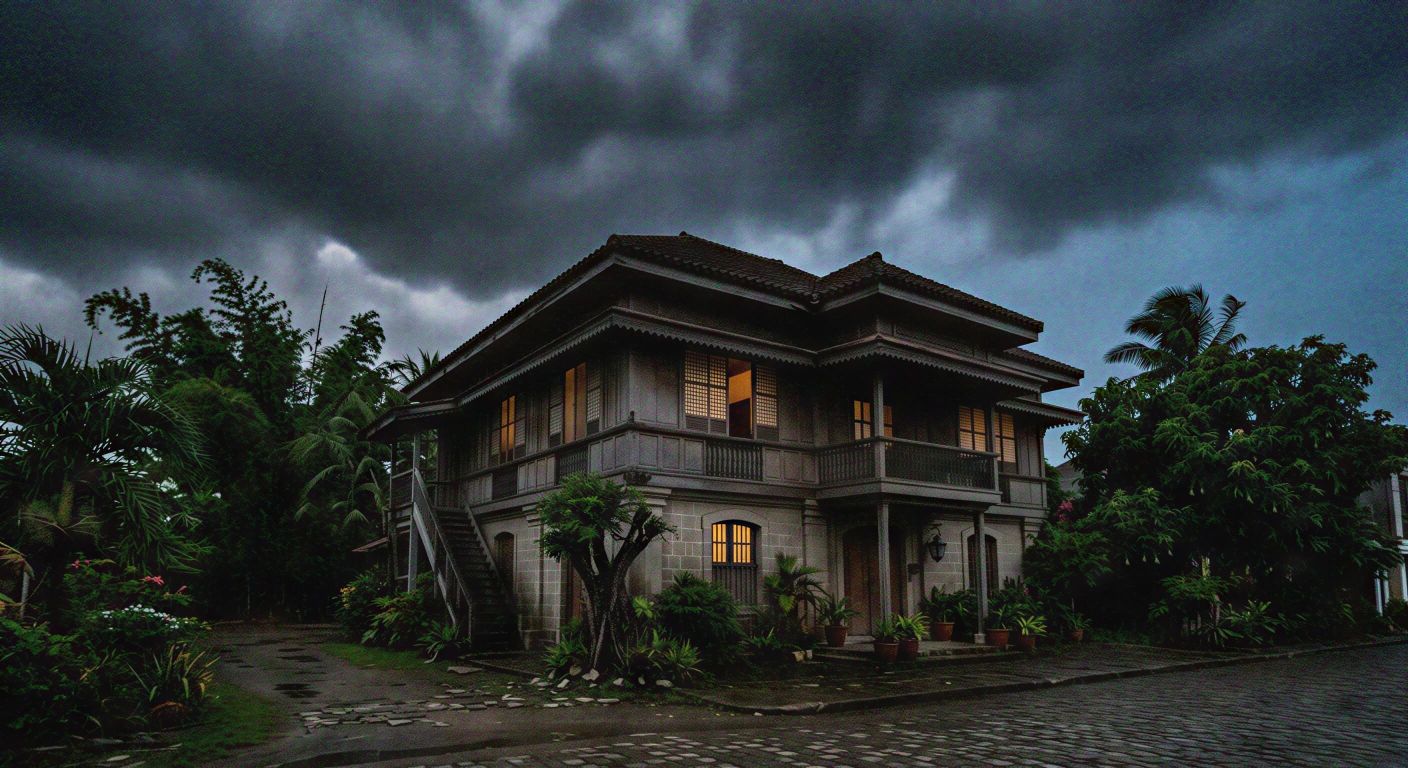
Ibarra walked rapidly with a far-away look in his eyes, while the aged servant followed him weeping. The sun was setting, and over the eastern sky was flung a heavy curtain of clouds. A dry wind shook the tree-tops and made the bamboo clumps creak. Ibarra went bareheaded, but no tear wet his eyes nor did any sigh escape from his breast. He moved as if fleeing from something, perhaps the shade of his father, perhaps the approaching storm. He crossed through the town to the outskirts on the opposite side and turned toward the old house which he had not entered for so many years. Surrounded by a cactus-covered wall it seemed to beckon to him with its open windows, while the ilang-ilang waved its flower-laden branches joyfully and the doves circled about the conical roof of their cote in the middle of the garden.
But the youth gave no heed to these signs of welcome back to his old home, his eyes being fixed on the figure of a priest approaching from the opposite direction. It was the curate of San Diego, the pensive Franciscan whom we have seen before, the rival of the alferez. The breeze folded back the brim of his wide hat and blew his guingón habit closely about him, revealing the outlines of his body and his thin, curved thighs. In his right hand he carried an ivory-headed palasan cane.
This was the first time that he and Ibarra had met. When they drew near each other Ibarra stopped and gazed at him from head to foot; Fray Salvi avoided the look and tried to appear unconcerned. After a moment of hesitation Ibarra went up to him quickly and dropping a heavy hand on his shoulder, asked in a husky voice, “What did you do with my father?”
Fray Salvi, pale and trembling as he read the deep feelings that flushed the youth’s face, could not answer; he seemed paralyzed.
“What did you do with my father?” again demanded the youth in a choking voice.
The priest, who was gradually being forced to his knees by the heavy hand that pressed upon his shoulder, made a great effort and answered, “You are mistaken, I did nothing to your father.”
“You didn’t?” went on the youth, forcing him down upon his knees.
“No, I assure you! It was my predecessor, it was Padre Damaso!”
“Ah!” exclaimed the youth, releasing his hold, and clapping his hand desperately to his brow; then, leaving poor Fray Salvi, he turned away and hurried toward his house. The old servant came up and helped the friar to his feet.
Recent Comments