Jose Rizal’s Noli Me Tangere remains one of the most influential literary works in Philippine history, serving as both a sharp political critique and a foundational cornerstone of national consciousness. Written during the height of Spanish colonial rule, this masterpiece boldly exposes the deep-seated corruption and systemic ailments that plagued late 19th-century Filipino society.
This comprehensive chapter index is designed to seamlessly guide modern readers through the classic English translation of Rizal’s groundbreaking work. To ensure complete accessibility for students, history enthusiasts, and global readers alike, the published chapters translated by Charles Derbyshire presented in this collection are sourced entirely from the public domain.
Click here to jump directly to the index of book chapters.
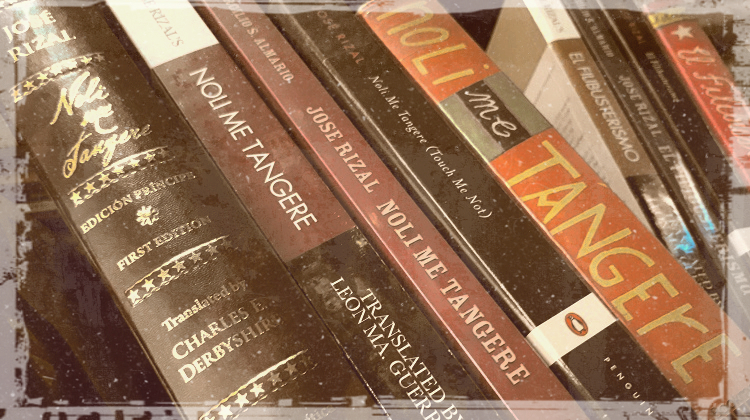
Noli Me Tangere Translation and Meaning
“Noli me tangere” is a Latin phrase which literally translates to “touch me not.” It is a reference to the biblical story told in the Gospel of John 20:17 in which the phrase is said to be Jesus’s first words upon his resurrection which he uttered to Mary Magdalene. He instructs her not to cling to him, because he had not yet ascended, which would then mark the change from his earthly state to a spiritual one.
Beyond its biblical association, Rizal, an ophthalmologist, also framed the phrase “noli me tangere” along medical and socio-political lines, referring first to cancerous ulcers so severe, touching them caused extreme pain to a patient. Rizal likened Philippine society as one suffering from a malignant cancer too painful to touch, under Spanish colonial rule.
Noli Me Tangere Book Summary
Idealistic young reformist, Crisostomo Ibarra, is back home in the Philippines following seven years of education in Europe. His optimism is crushed when he discovers that his father, the wealthy landowner Don Rafael, died in a miserable state in prison after being falsely accused of being a heretic and subversive by a tyrannical local friar.
Seeking to honor his father’s memory and uplift his hometown of San Diego, Ibarra puts all his efforts into establishing a modern, secular schoolhouse. At the same time, he rekindles his romance with Maria Clara, his childhood sweetheart.
His progressive views on education clash with the ruling Spanish clergy, who view the enlightenment of locals as a direct threat to their absolute colonial control. This institutional cruelty is mirrored across the town, most tragically, for example, through Sisa, a destitute mother driven to madness after the abusive friars exploit and cause the disappearance of her young sacristan sons.
To neutralize Ibarra, the corrupt friars plot a fake uprising and deliberately frame him as the leader of the revolt. Stripped of his fortune, his freedom, and his love, Ibarra only survives certain death with the help of Elias, a mysterious fugitive outlaw who rescues him in a high-stakes escape.
Noli Me Tangere (The Social Cancer) English Translation Complete Chapters
- Translator’s Introduction
- Author’s Dedication
- Chapter 1: A Social Gathering
- Chapter 2: Crisostomo Ibarra
- Chapter 3: The Dinner
- Chapter 4: Heretic and Filibuster
- Chapter 5: A Star in a Dark Night
- Chapter 6: Capitan Tiago
- Chapter 7: An Idyl on an Azotea
- Chapter 8: Recollections
- Chapter 9: Local Affairs
- Chapter 10: The Town
- Chapter 11: The Rulers
- Chapter 12: All Saints
- Chapter 13: Signs of Storm
- Chapter 14: Tasio: Lunatic or Sage
- Chapter 15: The Sacristans
- Chapter 16: Sisa
- Chapter 17: Basilio
- Chapter 18: Souls In Torment
- Chapter 19: A Schoolmaster’s Difficulties
- Chapter 20: The Meeting in the Town Hall
- Chapter 21: The Story of a Mother
- Chapter 22: Lights and Shadows
- Chapter 23: Fishing
- Chapter 24: In the Wood
- Special Chapter: Elias and Salome
- Chapter 25: In the House of the Sage
- Chapter 26: The Eve of the Fiesta
- Chapter 27: In the Twilight
- Chapter 28: Correspondence
- Chapter 29: The Morning
- Chapter 30: In the Church
- Chapter 31: The Sermon
- Chapter 32: The Derrick
- Chapter 33: Free Thought
- Chapter 34: The Dinner
- Chapter 35: Comments
- Chapter 36: The First Cloud
- Chapter 37: His Excellency
- Chapter 38: The Procession
- Chapter 39: Doña Consolación
- Chapter 40: Right and Might
- Chapter 41: Two Visits
- Chapter 42: The Espadañas
- Chapter 43: Plans
- Chapter 44: An Examination of Conscience
- Chapter 45: The Hunted
- Chapter 46: The Cockpit
- Chapter 47: The Two Señoras
- Chapter 48: The Enigma
- Chapter 49: The Voice of the Hunted[iv]
- Chapter 50: Elias’s Story
- Chapter 51: Exchanges
- Chapter 52: The Cards of the Dead and the Shadows
- Chapter 53: Il Buon Dí Si Conosce Da Mattina
- Chapter 54: Revelations
- Chapter 55: The Catastrophe
- Chapter 56: Rumors and Belief
- Chapter 57: Vae Victis!
- Chapter 58: The Accursed
- Chapter 59: Patriotism and Private Interests
- Chapter 60: Maria Clara Weds
- Chapter 61: The Chase on the Lake
- Chapter 62: Padre Damaso Explains
- Chapter 63: Christmas Eve
- Epilogue
- Glossary
Listen to the Complete English Audiobook Version of the Book Chapters
Access the full YouTube playlist below to listen to the complete English audiobook version of Noli Me Tangere by Jose Rizal, as translated to The Social Cancer by Charles Derbyshire.
Why Charles Derbyshire Chose the Title, The Social Cancer
Rather than choosing the literal translation “touch me not” as the title of his translated version of Noli Me Tangere, Derbyshire opted to use The Social Cancer, a decision rooted in Rizal’s own intentions as noted in his dedication of the book where he said:
Recorded in the history of human sufferings is a cancer of so malignant a character that the least touch irritates it and awakens in it the sharpest pains… Desiring thy welfare… I will strive to do with thee what the ancients did with their sick: expose them on the steps of the temple so that every one who came to invoke the Divinity might offer them a remedy.” – Jose Rizal | A Mi Patria (To My Fatherland) Noli Me Tangere dedication
Analyzing his title choice, Derbyshire’s The Social Cancer aligns with Rizal’s purpose, to diagnose and expose the rotten socio-political and religious systems that had festered, corrupted and consumed Philippine culture and society to its detriment.
About The Social Cancer Translator, Charles Derbyshire
As an American academic and language specialist, Charles Edward Derbyshire (1880–1933) played a foundational role in opening early Philippine literature to English-speaking audiences during the onset of the twentieth century.
A native of Huntington, West Virginia, Derbyshire completed his higher education at West Virginia University and Marshall College. He began his professional path by instructing students in Spanish at Marshall College at the turn of the century.
In 1901, he relocated across the Pacific to the Philippines, journeying aboard the transport ship Thomas. Over the subsequent decade, he worked as a classroom educator within the island nation. His linguistic capabilities eventually transitioned him into governmental administration, where he served as an official translator for the Executive Bureau and subsequently for the country’s Supreme Court until 1916.
Derbyshire’s most enduring historical legacy is anchored to his literary work with the writings of the Philippine national hero, José Rizal. In 1912, he published the first complete, unabridged English editions of Rizal’s most influential novels. He rendered Noli Me Tángere under the English title The Social Cancer and its political sequel, El Filibusterismo, as The Reign of Greed.
Accompanied by extensive contextual introductions, Derbyshire’s volumes stood as the definitive English interpretations of Rizal’s masterpieces for generations, heavily reprinted until newer translations emerged in the mid-to-late 1900s. Beyond these primary novels, he also translated Rizal’s poetry and previously unpublished manuscript chapters.
Following his extensive service in the Philippines, Derbyshire returned to his home state to resume his teaching duties at Marshall College. He passed away in Chillicothe, Ohio, in the spring of 1933 at the age of 53.
Other Notable Book Versions and Translations
Throughout the decades, there have been hundreds of versions of Noli Me Tangere. Excluding textbooks, illustrated novels and abridged educational materials, below are the most notable translations of the book.
Available for International English Readers
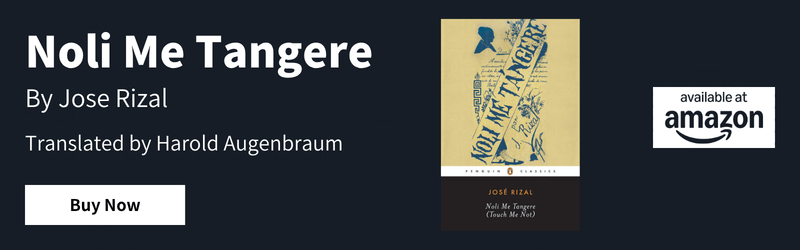
- Noli Me Tangere (2006): Translated by Harold Augenbraum and published by Penguin Classics, this marked the first time the book became readily accessible to the global market.
Other Major English Translations
- An Eagle Flight (1900): Anonymous. Published in New York. This was the first English version, and was a shortened version based on a French edition.
- Friars and Filipinos (1902): Translated by Frank Ernest Gannett. Written at a time when the Philippines had just become an American colony, it came with a noticeably political tone intended for the American public.
- The Social Cancer (1912): Translated by Charles Derbyshire. This became the standard English translation for the remaining half of the 1900s.
- Noli Me Tangere: An Unexpurgated Translation (1956): Translated by Jorge Bocobo, who kept the stinging anti-clerical criticisms entirely intact.
- Noli Me Tángere: A Complete English Translation (1956): Translated by Senator Camilo Osías, often cited for his accuracy.
- The Lost Eden (1961): Translated by León Ma. Guerrero. Commissioned for the Rizal centennial, and modernized with contemporary English. Guerrero’s translation would go on to be republished a number of times including in 2015 for Guerrero Publishing and in 2019 for Dover Publications.
- Noli Me Tangere (1989): Translated by Jovita Ventura Castro. Published under the ASEAN Committee on Culture and Information.
- Noli Me Tangere (1996): Translated by Soledad Lacson-Locsin, it is widely regarded as a faithful and elegant English version, with Locsin working directly from facsimiles of Rizal’s original Spanish manuscripts.
- Noli Me Tangere (2011): Critical Edition by Isaac Donoso Jimenez. This bilingual edition puts Derbyshire’s English and Rizal’s original Spanish text side by side and is enriched by Juan Luna’s illustrations and Rizal’s notes.
- Noli Me Tangere: A Shortened Version in Modern English (2016): Translated and condensed by Nicholas Tamblyn.
Other International Translations
- French: Au Pays des Moines (In the Land of the Monks) (1899): Translated by Henri Lucas and Ramón Sempau. This is the first translation of the novel into any language.
- Dutch: Noli me Tangere: Filippijnsche Roman (Noli Me Tangere: Filipino Novel) (1912): Translated by Abraham Anthony Fokker. Published by Soerabaijasch Handelsblad, this was instrumental in showing the experience of Spanish colonial rule to a wider Western readership.
- Indonesian: Jangan Sentuh Aku (Noli me Tángere) (1975): Translation by Tjetje Jusuf. Published by Dunia Pustaka Jaya. This version is significant for having brought Rizal’s liberal ideas to a neighboring Southeast Asian audience.
- French: N’y Touchez Pas! (Don’t Touch It!) (1980): Translation by Jovita Ventura Castro under the UNESCO Collection of Representative Works.
- German: Noli Me Tangere (Rühre Mich Nicht An) (1987): Translated by Annemarie del Cueto-Mörth to mark the centenary of the book’s original 1887 printing in Berlin.
- Italian: Noli me tángere (2003): Translated by Vasco Caini. Published by Debatte editore.
- Korean: 나를 만지지 마라 (Nareul Manjiji Mara, Touch Me Not) (2015): Translated by Kim Dong-yeop. Published by Nulmin Publishing House in two parts.
- Czech: Noli Me Tangere (2023): Translated by Dusan Safr Ospalik: Published by Continual Progress.
Major Tagalog Translations
- Huag Acong Salangin Nino Man (1906): Translated by Pascual H. Poblete. This is the first translation into Tagalog.
- Noli Me Tangere (1946): Translated by Domingo D. de Guzman, Francisco Laksamana and María Odulio de Guzman.
- Noli Me Tangere (1961): Translated by Patricio Mariano. This became the standard literary Tagalog translation of the 20th century.
- Noli Me Tangere (1997): Translated by Virgilio S. Almario, a National Artist for Literature.
- Noli Me Tangere (1999): Translated by Ofelia Jamilosa-Silapan, from the English translation by Leon Ma. Guerrero.
Recent Comments