Chapter 10: The Town
Almost on the margin of the lake, in the midst of meadows and paddy-fields, lies the town of San Diego.[1] From it sugar, rice, coffee, and fruits are either exported or sold for a small part of their value to the Chinese, who exploit the simplicity and vices of the native farmers.
When on a clear day the boys ascend to the upper part of the church tower, which is beautified by moss and creeping plants, they break out into joyful exclamations at the beauty of the scene spread out before them. In the midst of the clustering roofs of nipa, tiles, corrugated iron, and palm leaves, separated by groves and gardens, each one is able to discover his own home, his little nest. Everything serves as a mark: a tree, that tamarind with its light foliage, that coco palm laden with nuts, like the Astarte Genetrix, or the Diana of Ephesus with her numerous breasts, a bending bamboo, an areca palm, or a cross.
Yonder is the river, a huge glassy serpent sleeping on a green carpet, with rocks, scattered here and there along its sandy channel, that break its current into ripples. There, the bed is narrowed between high banks to which the gnarled trees cling with bared roots; here, it becomes a gentle slope where the stream widens and eddies about. Farther away, a small hut built on the edge of the high bank seems to defy the winds, the heights and the depths, presenting with its slender posts the appearance of a huge, long-legged bird watching for a reptile to seize upon.
Trunks of palm or other trees with their bark still on them unite the banks by a shaky and infirm foot-bridge which, if not a very secure crossing, is nevertheless a wonderful contrivance for gymnastic exercises in preserving one’s balance, a thing not to be despised. The boys bathing in the river are amused by the difficulties of the old woman crossing with a basket on her head or by the antics of the old man who moves tremblingly and loses his staff in the water.
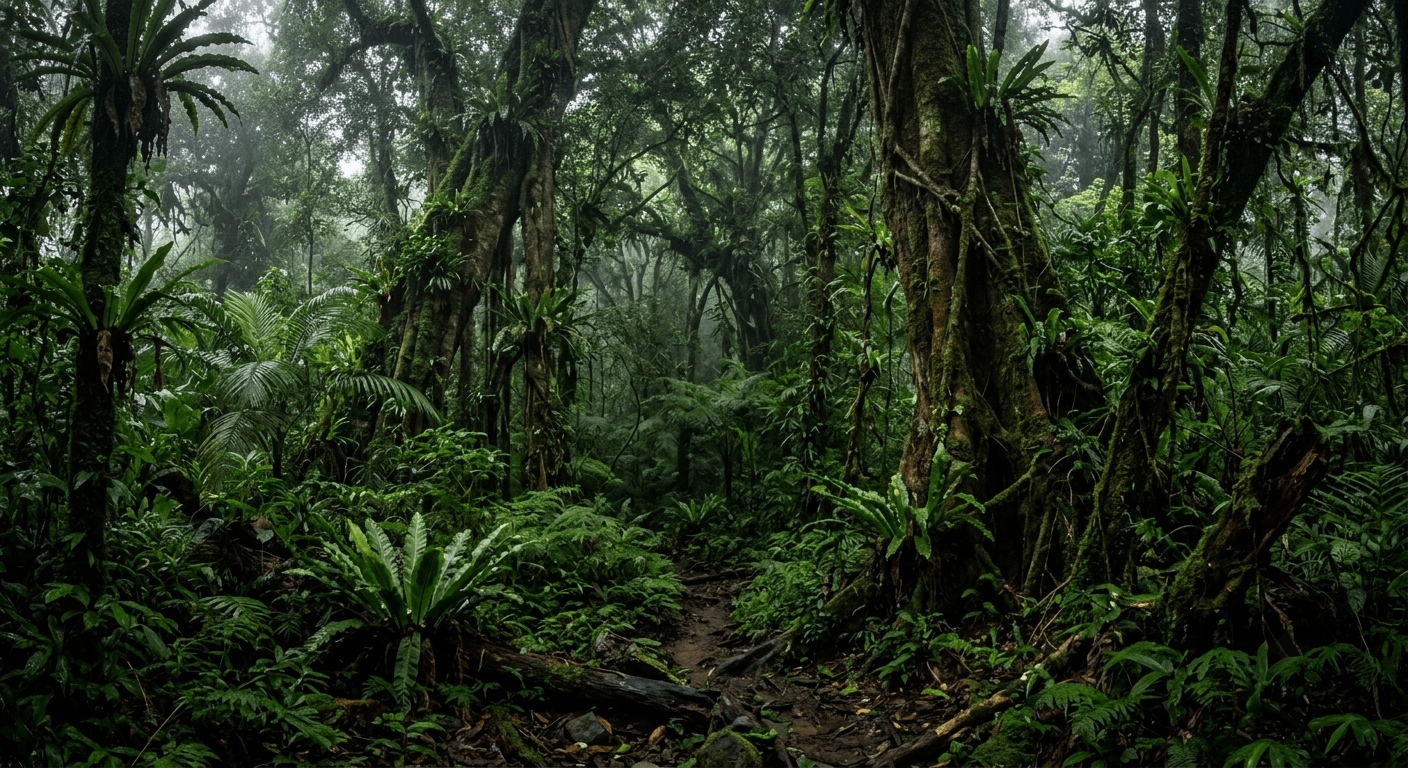
But that which always attracts particular notice is what might be called a peninsula of forest in the sea of cultivated fields. There in that wood are century-old trees with hollow trunks, which die only when their high tops are struck and set on fire by the lightning—and it is said that the fire always checks itself and dies out in the same spot. There are huge points of rock which time and nature are clothing with velvet garments of moss. Layer after layer of dust settles in the hollows, the rains beat it down, and the birds bring seeds.
The tropical vegetation spreads out luxuriantly in thickets and underbrush, while curtains of interwoven vines hang from the branches of the trees and twine about their roots or spread along the ground, as if Flora were not yet satisfied but must place plant above plant. Mosses and fungi live upon the cracked trunks, and orchids—graceful guests—twine in loving embrace with the foliage of the hospitable trees.
Strange legends exist concerning this wood, which is held in awe by the country folk. The most credible account, and therefore the one least known and believed, seems to be this.
When the town was still a collection of miserable huts with the grass growing abundantly in the so-called streets, at the time when the wild boar and deer roamed about during the nights, there arrived in the place one day an old, hollow-eyed Spaniard, who spoke Tagalog rather well. After looking about and inspecting the land, he finally inquired for the owners of this wood, in which there were hot springs. Some persons who claimed to be such presented themselves, and the old man acquired it in exchange for clothes, jewels, and a sum of money. Soon afterward he disappeared mysteriously.
The people thought that he had been spirited away, when a bad odor from the neighboring wood attracted the attention of some herdsmen. Tracing this, they found the decaying corpse of the old Spaniard hanging from the branch of a balete tree.[2] In life he had inspired fear by his deep, hollow voice, his sunken eyes, and his mirthless laugh, but now, dead by his own act, he disturbed the sleep of the women. Some threw the jewels into the river and burned the clothes, and from the time that the corpse was buried at the foot of the balete itself, no one willingly ventured near the spot.
A belated herdsman looking for some of his strayed charges told of lights that he had seen there, and when some venturesome youths went to the place they heard mournful cries. To win the smiles of his disdainful lady, a forlorn lover agreed to spend the night there and in proof to wrap around the trunk a long piece of rattan, but he died of a quick fever that seized him the very next day. Stories and legends still cluster about the place.
A few months after the finding of the old Spaniard’s body there appeared a youth, apparently a Spanish mestizo, who said that he was the son of the deceased. He established himself in the place and devoted his attention to agriculture, especially the raising of indigo. Don Saturnino was a silent young man with a violent disposition, even cruel at times, yet he was energetic and industrious. He surrounded the grave of his father with a wall, but visited it only at rare intervals. When he was along in years, he married a young woman from Manila, and she became the mother of Don Rafael, the father of Crisostomo.
From his youth Don Rafael was a favorite with the country people. The agricultural methods introduced and encouraged by his father spread rapidly, new settlers poured in, the Chinese came, and the settlement became a village with a native priest. Later the village grew into a town, the priest died, and Fray Damaso came.
All this time the tomb and the land around it remained unmolested. Sometimes a crowd of boys armed with clubs and stones would become bold enough to wander into the place to gather guavas, papayas, lomboy, and other fruits, but it frequently happened that when their sport was at its height, or while they gazed in awed silence at the rotting piece of rope which still swung from the branch, stones would fall, coming from they knew not where. Then with cries of “The old man! The old man!” they would throw away fruit and clubs, jump from the trees, and hurry between the rocks and through the thickets; nor would they stop running until they were well out of the wood, some pale and breathless, others weeping, and only a few laughing.
Chapter 10 Notes:
1. We have been unable to find any town of this name, but many of these conditions. —Author’s note.
San Diego and Santiago are variant forms of the name of the patron saint of Spain, St. James. —TR.
2. The “sacred tree” of Malaya, being a species of banyan that begins life as a vine twining on another tree, which it finally strangles, using the dead trunk as a support until it is able to stand alone. When old it often covers a large space with gnarled and twisted trunks of varied shapes and sizes, thus presenting a weird and grotesque appearance. This tree was held in reverent awe by the primitive Filipinos, who believed it to be the abode of the nono, or ancestral ghosts, and is still the object of superstitious beliefs. —TR.
Recent Comments