So, more than a hundred years ago, Filipino fairs had friar figurines and talking heads. Hardly an ideal paring, but would certainly have been quite the amusement, if only they had some popcorn and soda.
Chapter 16: The Tribulations of a Chinese
The Chinese Quiroga, who hopes to open a consulate for his nation, hosts a dinner for important people from the church, government, military and business.
Some merchants gather around Simoun complaining about the difficulties of doing business in the country in the hopes that Simoun will pass on their ideas for solutions to the Captain-General. Quiroga too shares his difficulties with Simoun about a bribe he had attempted to pull off with Simoun’s jewellery that had resulted instead in a financial loss. Simoun offers to reduce Quiroga’s debt if Quiroga agrees to temporarily keep some rifles for him. Quiroga agrees.
Later, some of the guests, including Don Custodio, Ben Zayb, Juanito Pelaez, Simoun and Padres Salvi, Camorra and Irene decide to head off to the Quiapo Fair to see a head which an American, Mr. Leeds has been exhibiting.
Chapter 17: The Quiapo Fair
Spotted at the fair is the exquisitely beautiful Paulita Gomez, accompanied by Isagani and Dona Victorina, who calls out to her favorite, Juanito Pelaez.
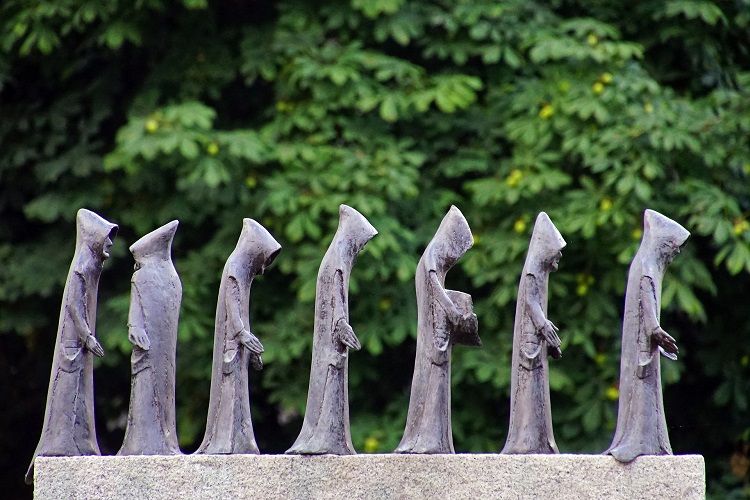
The group from Quiroga’s dinner stroll around the fair and stop by a stall of figurines, majority of which are figures of priests. Unlike the depictions of priests in Europe, who are shown participating in worldly activities or having fun, the priests’ figurines in the stall are elegant, saintly and serene.
Chapter 18: Legerdemain[1]
At Mr. Leeds’ room, Ben Zayb examines the table for mirrors, which he thinks is the trick behind the exhibit. Finding none, Mr. Leeds produces a box containing some ashes and a piece of papyrus which he supposedly found during a visit to the pyramid of Khufu.[2] Leeds pronounces a word from the papyrus and the box reveals the head of a cadaver. Leeds commands the head to tell its story.
The head introduces himself as Imuthis, whose life was ruined after returning home from his studies abroad and discovering the secret of the governing impostor, Gaumata. With the help of tyrannical Egyptian priests, Gaumata engineers the ruin of Imuthis through the young priest Abydos, who coveted the woman Imuthis loved. Abydos falsely implicated Imuthis in a rebellion, which led to the death of Imuthis in a lake during an attempted escape.
Padre Salvi recognizes the similarities between the story of Imuthis and events of his past.[3] He collapses in terror, calls for mercy and declares some woman still lives.
Chapter 19: The Fuse
Placido Penitente is enraged by his experience at the university. Back at his rented room, he finds his mother, Cabesang Andang on a visit. He narrates what happened to him, and his mother reminds him of both their sacrifices and asks him to be patient and humble.
Placido leaves to escape his mother and sees Simoun with whom he shares his story. Simoun invites him to tag along, and they make their way to the house of a pyrotechnist. Placido hears the two talk about bombs, and an event that is to happen the following week involving Cabesang Tales and his men, which, if delayed, may mean death for Maria Clara.
Placido later spends a few hours at Simoun’s house from which he emerges thoughtful. He later agrees to his mother’s plan to try to appease the friars at his university.
Alone at his house, Simoun is momentarily bothered by his conscience, but quickly turns away from it.
Chapter 20: The Arbiter
Don Custodio has been thinking about the students’ petition for a Spanish academy for many days, wanting to please both those who are for and against it.
Who is Don Custodio? He met with some success after using his wife’s money to go into business, which led to numerous distinguished appointments. He once returned to Spain from where he gathered an assortment of ideas, which he then implemented in unusual projects in the Philippines which others criticized.
Regarding his opinion of the native population, he thinks them only fit for mechanical work and imitative arts, and refuses to think them capable of being distinguished. Don Custodio is Catholic, but only because he thinks it necessary to be so among backward people. In the Philippines, he thinks the friars are necessary and are superior colonial masters. It is because of this that the friars think favorably of him.
As he continues to think about the petition, his eyes land on one of his project files concerning the School of Arts and Trades. He gets an idea (which he doesn’t reveal yet) and declares he has arrived at a decision.
Notes and References:
1. Trickery
2. The oldest and largest pyramid in Giza
3. Except for the time period and setting, Imuthis’ story is nearly the same as the story of Ibarra, Maria Clara and Padre Salvi in Noli Me Tangere. Rizal, Jose. Noli Me Tangere. Translated by Harold Augenbraum. USA: Penguin Group, 2006.
Recent Comments