• Skip to main content
  • Skip to secondary menu
  • Skip to primary sidebar
  • Skip to footer
  • Home
  • About
  • Contact

Pinoy Wit

Cultivating the Filipino soul through culture and history

  • Culture
  • Culinary Heritage
  • History
  • Film
  • Books & Literature
  • Natural Heritage

Divine Mercy Shrine in El Salvador Misamis Oriental

August 12, 2013 by Ninah Villa

Rudy, who left a comment on the video I shot says it all, “Spain in the Philippines.”

Of course, those of us who live here know he isn’t referring to the structure itself. There is no Spanish influence anywhere on it. Rudy was referring to the religious and perhaps spiritual fervor that is the influence of more than 300 years of colonial rule that has resulted in the creation of shrines like this one.


Tucked away in the quiet hills of barangays PSB and Ulaliman in El Salvador Misamis Oriental is the Divine Mercy Shrine. Popular among both tourists and pilgrims, you would not imagine that its origins are fraught with uncertainty.

As the story goes, a local charismatic group first began receiving visions in the year 2000. They were told to build a church on top of a hill overlooking the sea. Initially beset with fears, doubts and financial uncertainty, the group did not take immediate steps in answer to the visions.

When they did decide to take action, the search for land on which to start building was long and arduous. Among the places they originally visited were Surigao, Camiguin and Davao. It was only in El Salvador however that the group received signs that they interpreted to mean that they had found the location.

With only 2,000 pesos in funds, work began on the shrine in 2003. Today the shrine is within the Divine Mercy Hills which spans 9.8 hectares. At its heart is a 50 foot statue of Jesus overlooking Macajalar Bay. It is currently the biggest statue in the world for the Divine Mercy.

The blood and water streaming from the heart of Jesus are made of glass and tiles and encase stairs leading to a chamber of adoration. At the base of the statue are reconciliation rooms.

The statue alone attracts visitors in droves. Numerous testimonials, healings, conversions and answered prayers have since been reported.
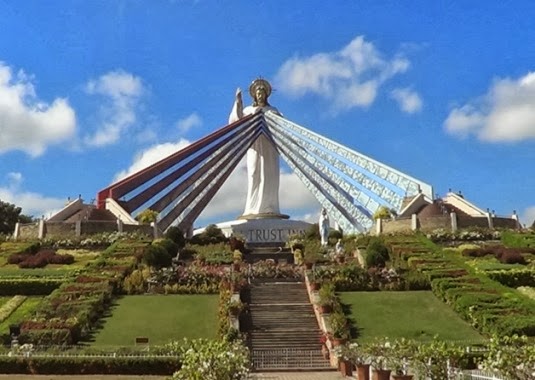
The 50 foot statue of the Divine Mercy

Once completed, the ongoing development project will also feature a church, retreat facilities and places for reflection. Construction is now largely funded by donations. It is currently jointly managed by the Divine Mercy Foundation of Mindanao, Inc., The Congregation of the Marians of the Immaculate Conception of the Most Blessed Virgin Mary, Inc. and the Archdiocese of Cagayan de Oro.

To get to the shrine, you can ride a public jeepney in the Bulua terminal in Cagayan de Oro City. The trip will take no more than 30 minutes. At PSB-Ulaliman you can ride up to the entrance of the shrine on a motorcycle for hire. Another option is to take a 15 minute walk up.

To enter the shrine, visitors are required to wear proper clothing. Shorts and sleeveless shirts are not permitted. Long skirts and pants are provided at the entrance.

For more information on the shrine, visit www.divinemercyhills.com.

Filed Under: Cultural Heritage Tagged With: Misamis Oriental

Primary Sidebar

Looking for Something?

Read About

  • Books & Literature
  • Culinary Heritage
  • Cultural Heritage
  • Film & Television
  • Natural Heritage
  • Philippine History
  • Thoughts
  • Town Bulletin

Books & Literature

the Virgin of Antipolo, Our Lady of Peace and Prosperous Voyages

Noli Me Tangere Chapter 6 English Translation

Chapter 6: Capitan Tiago Thy will be done on earth. While our characters are deep in slumber or busy with their breakfasts, let us turn our attention to Capitan Tiago. We have never had the honor of being his guest, so it is neither our right nor our duty to pass him by slightingly, even […]

boat on water under dark skies

Noli Me Tangere Chapter 5 English Translation

Chapter 5: A Star in a Dark Night Ibarra went to his room, which overlooked the river, and dropping into a chair gazed out into the vast expanse of the heavens spread before him through the open window. The house on the opposite bank was profusely lighted, and gay strains of music, largely from stringed […]

Calle Crisologo in Vigan, Ilocos Sur

Noli Me Tangere Chapter 4 English Translation

Chapter 4: Heretic and Filibuster Ibarra stood undecided for a moment. The night breeze, which during those months blows cool enough in Manila, seemed to drive from his forehead the light cloud that had darkened it. He took off his hat and drew a deep breath. Carriages flashed by, public rigs moved along at a […]

Film & TV

general luna street cagayan de oro

Demystifying the Heneral Luna Phenomenon – A Movie Review

I woke up to a most singular occurrence, Tuesday last week. Heneral Luna, an indie historical film which had opened quietly the week before, had begun trending in Twitter at 4 a.m. Like the brash and vitriolic general of the same name, it had refused to fade calmly into obscurity and continued to pop in […]

bayan ko GMA TV series

Bayan Ko TV Series Review

I saw one episode of this series on GMA News TV and was impressed. So even if this two disc set seemed a bit expensive at roughly Php400 each, I bought them anyway. I support anything Filipino made that’s better than the usual evening cookie cutter drama fare. Its fictional but faithful account of what […]

Heritage Travel Philippines

The Noli Project

Access the Noli Me Tangere index of chapter summaries in English here.

The El Fili Project

Access the El Filibusterismo index of chapter summaries in English here.

Footer

Resources

Noli Me Tangere Chapter Summaries
El Filibusterismo Chapter Summaries
OPM Featuring Filipino Culture

Recent Comments

  • ROSALIE CAZENAS YNTE on The Rise of Felip and His Bisaya Songs – From P-Pop Idol to Heritage Champion
  • Eloisa Pascual on The Rise of Felip and His Bisaya Songs – From P-Pop Idol to Heritage Champion
  • Eloisa Pascual on The Rise of Felip and His Bisaya Songs – From P-Pop Idol to Heritage Champion
  • Mica on The Rise of Felip and His Bisaya Songs – From P-Pop Idol to Heritage Champion
  • Marilou Tinambacan on The Rise of Felip and His Bisaya Songs – From P-Pop Idol to Heritage Champion

Tags

American colonial rule ancestral houses Andres Bonifacio Bantayan Island Bicol Region bookstores Cagayan de Oro camiguin island Cebu el filibusterismo Felip government Misamis Oriental National Symbols Natural Calamities noli me tangere Noli Me Tangere English Translation Old Churches OPM Pampanga pre colonial Spanish colonial period

© 2026 · Pinoy Wit · | N. Villa
Privacy Policy